
Requirements for Continuous Manufacturing & 3 Phases of Implementation
The maintenance requirements of continuous production plants
Plant and process design, maintenance philosophies, strategies, tactics, and operational interventions require serious consideration given the complexity, criticality, and 24/7 nature of continuous manufacturing.
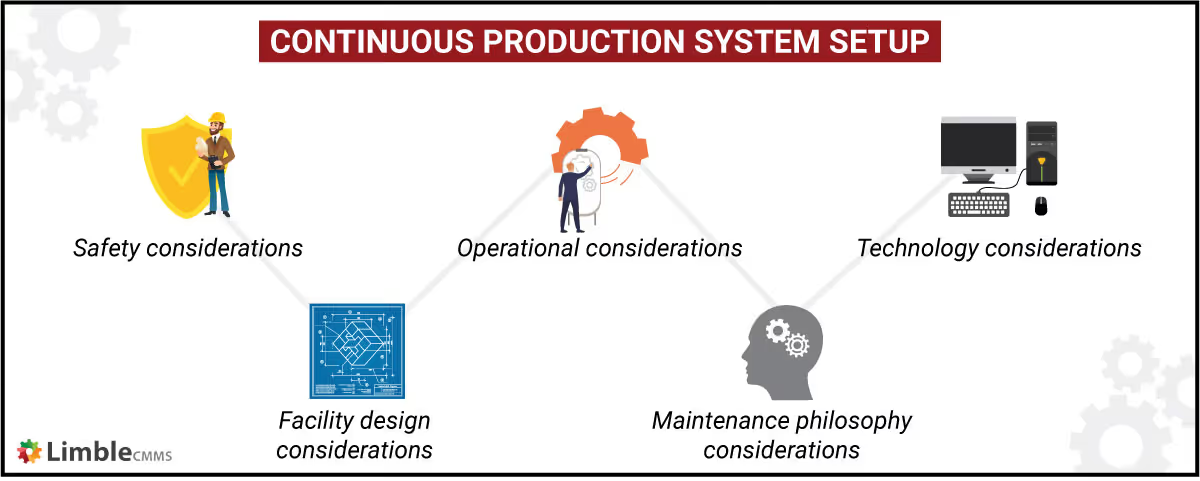
Facility design considerations
The above-mentioned considerations often occur only after the plant has been built and operations staff employed. To increase the maintainability of a continuous production plant, engineering and maintenance assessments should happen during the design phase of the manufacturing asset/plant.
With maintenance interventions planned annually at best, the in-service reliability of the individual equipment should be factored into the total cost of ownership (TCO) decisions that drive purchasing recommendations. Similarly, one should perform FMECA studies into process flows to drive decisions on factory layout, equipment redundancy assessments, and spares inventory.
Maintenance philosophy considerations
It is highly recommended to perform reliability-centered maintenance before committing to one or a mix of maintenance strategies and technology. Some manufacturers might also want to look into total productive maintenance and business-centered maintenance.
They both feature many interesting practices, some of which might be a good match for your operational needs.In general, strategic decisions on reactive, preventive, condition-based, and predictive maintenance will evolve from the RCM, FMECA studies, and a maintenance philosophy selection.In continuous production facilities, preventative maintenance will usually occur in paralleled processes providing system redundancy.
Condition-based maintenance practices will form the bulk of the strategy given the infrequency of maintenance shutdowns. Predictive and prescriptive maintenance will target the assets incurring high costs from downtime or maintenance.
Technology considerations
RCM, as well as predictive and prescriptive maintenance, demand extensive and comprehensive data collection, storage, and analysis. Aside from specialized software, companies can use modern CMMS software to manage condition and performance data coming from continuous production assets. Before that, assets have to be retrofitted, or come with, proper sensor equipment.
Giving insight into the maintenance function, a CMMS reduces the need for reactive maintenance interventions, which can have prohibitive cost implications in a continuous production system. When coupled with predictive maintenance analytics, CMMS users can look at deterioration trends to predict when the asset will fail.
This way, maintenance planners and managers have plenty of time to allocate the necessary resources and schedule maintenance - which is extremely beneficial in the context of continuous manufacturing.
Operational considerations
Planned downtimes are very far apart, and there is a high time pressure on the length of such maintenance windows. This can seriously complicate the decisions on maintenance staffing.
Should you keep maintenance in-house or outsource everything? It will largely depend on the cost and availability of suitably qualified contractors. This is a very important decision as it directly impacts the size of your spare parts inventory, securing access to specialized tooling, and the arrangement of other internal resources.
Lastly, technology obsolescence and equipment upgrades also require careful consideration to ensure they are appropriately planned, resourced, and scheduled.
Safety considerations
While safety is a critical component of all maintenance interventions, maintenance shutdowns at continuous production facilities require extra planning. With strict time constraints, the economic pressures of exceeding planned shut deadlines create commercial pressures.
What do safety incidents and equipment failures have in common? They are both often caused by human errors. And those errors are more likely to happen when you’re in a rush. That’s not all. A planned maintenance shutdown of a continuous production system will require multiple trades to work in close proximity or over and under each other.
Testing by one maintenance team must be carefully choreographed with others in the area to avoid exposure to moving equipment, electricity, or stored energy. It is paramount that workers follow LOTO guidelines and other safety procedures.
Continuous production facilities such as chemical plants will have additional safety concerns to address during maintenance shutdowns. Some chemicals require continuous circulation, agitation, or heating - even while shut down for maintenance. Tie-ins or cut-ins for upgrades or replacement will expose maintenance crews to danger. Planning for such maintenance periods typically begins months, or even years, ahead of time.
How to set up a continuous production system
With the capital intensity and complexity of sizable continuous production facilities, planning and preparation are key. However, even a small to medium-sized manufacturer seeking to move to continuous production from jobbing or batch manufacturing will need to do some serious thinking.
Initiating a project mindset for such a setup is useful.
1) The feasibility phase
Headed by an individual with in-depth knowledge of production, a feasibility phase should be planned and funded with cross-organizational representation. Key roles involved in the planning phase would include production, engineering & maintenance, financial, quality, and safety personnel.
2) The planning phase
The required decisions will begin with the manufacturing philosophy that drives equipment selection. Highly standardized products in high volumes allow specialized or single task equipment selection or manufacturing:
- Is there a facility to use multi-role equipment to provide redundancy or backup?
- How likely is a change in product specification or client requirements?
These decisions often call for a trade-off between capital expenditure now and potential operational expenditure in the future.
Control and monitoring strategies are crucial in continuous production, where maintaining quality within an operating line allows timely intervention from alerts or advisories, ensuring consistent in-specification output:
- How will sampling be enacted?
- Using process analytical technology (PAT), will process measurements utilize sensors to measure the performance attributes of the process itself or raw in-process material quality that software may translate into the required attributes?
- Will sampling be online, at-line, or off-line?
Each selection will drive decisions on technology and personnel, mitigating the risk of non-conforming products.
3) The implementation phase
When everything is mapped out, the “only” thing left to do is put things into motion. Setting up a manufacturing plant can be an article in itself so we will not even try to wrestle with that here.
During the implementation phase, keep a strong focus on the interconnectedness of the devices and the technology you use. The ability to produce, store, track, and analyze asset data will be key for optimizing the production process.
Your maintenance software should be linked with asset condition and performance data, predictive analytics, as well as inventory and planning systems. This way, the pre-maintenance-shutdown preparation will ensure workload leveling, skill requirement identification, spares availability, and correct maintenance and upgrade task scheduling.
Summary
Continuous production manufactures large quantities of products with few variations, relying on high levels of standardization of processes, procedures, tools, and equipment. With material in continuous movement through a series of operations, and a workforce operating 24/7, the cost impost, quality issues, and product waste resulting from stoppages demand comprehensive design and maintenance considerations.
With equipment downtime restricted to infrequent maintenance shutdowns, the design of a comprehensive maintenance strategy - supported by targeted data collection and analysis using a modern computerized maintenance management system - are the minimum components required to create a sustainable continuous production system.
Maintenance shutdowns on a continuous production facility are always high-pressure events.
We owe it to ourselves and our workforce to ensure that the necessary design, planning, and scheduling processes we employ support a professional, effective and safe event, reinstating the expected reliability and performance standards that minimize the total cost of ownership and maximize equipment performance.