How a Global Industrial Manufacturer Flipped Its Planned-to-Unplanned Ratio in Two Years
By Hila Landesman, Limble Customer Success Manager
At a glance
- Before Limble: No work order system, no PM program, no parts tracking, no reporting
- Two years later: Planned work now outpaces unplanned work, and the lead is growing
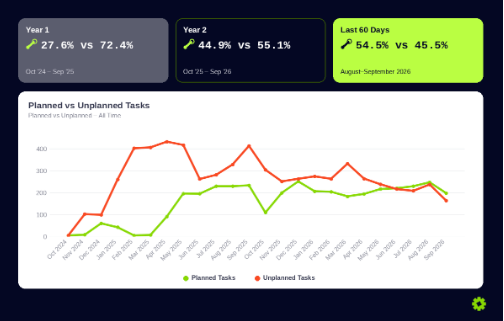
- All-time split: 37% planned vs. 63% unplanned
- Last 60 days: 54.5% planned vs. 45.5% unplanned (Aug – Sep 2026)
The problem: everything ran through one person
Two years ago, our client’s maintenance operation had no system for anything. Work orders weren't tracked. There was no preventive maintenance program, no parts tracking, and no way to report on what maintenance was actually doing.
That gap showed up in accountability, too. Nobody had visibility into what the team was working on day to day. There were no maintenance supervisors or team leads, so every decision and every fire ran through the facility manager — including shifts with no maintenance coverage at all. The team wanted to grow, but there was no structure to grow into.
This is a familiar starting point. Most maintenance teams don't lack effort; they lack a system that makes the work visible.
What changed
This customer put Limble’s CMMS in place and, more importantly, used it. Work orders moved out of people's heads and email threads and into a shared system. Preventive maintenance got scheduled instead of skipped. Parts and reporting became things the team could actually see, not just talk about.
None of that fixes a broken maintenance program overnight. What it does is provide true maintenance intelligence: showing a team exactly where its time is going — and that visibility is where the real gains start.
The result: planned work is overtaking unplanned work, and pulling further ahead
Two years in, the numbers tell the story. Across the full two years, this customer has logged 63% of tasks as unplanned versus 37% planned — a ratio that still reflects where the team started. But the trend line is what matters: over the last 120 days, planned work is already ahead, 51.98% to 48.02%. Narrow the window to the last 60 days, and the gap widens further — 54.5% planned versus 45.5% unplanned. This isn't a one-month blip; it's a trend that's been building and accelerating.
That flip matters more than the raw percentage. Maintenance teams generally aim for a 70/30 or 80/20 planned-to-unplanned split, and on critical assets, high-performing teams push toward 95/5. This client isn't there yet — but moving from a program with no PM schedule at all to a planned-work majority, with that majority growing month over month, is the leading indicator that the trend is real.
The team is also doing more work overall: they're now averaging roughly 450 completed tasks a month, with nearly 10,000 logged in Limble all-time. That volume moving through a shared system — instead of radios and tribal knowledge — is what makes the planned/unplanned numbers trustworthy in the first place.
Why it matters
A team that's mostly reactive is a team that's always behind: no coverage on some shifts, no accountability for who's doing what, work piling up faster than it clears. A team that's mostly planned is a team that can staff ahead of the work, catch failures before they happen, and make the case for more headcount with numbers instead of guesswork.
Now, this company is looking at expanding Limble to additional sites — proof that once a team can see its own data, it wants more of it. That’s true maintenance intelligence.
One more thing: when a vendor's shutdown became a data problem
Partway through this relationship, our client hit an unplanned crisis of a different kind. One of the outside contractors handling their preventive maintenance was going out of business, taking with it the only record of how to maintain a fleet of custom-built machines. The handoff arrived as dozens of pages of PDFs: asset diagrams with notes on PM steps and what needed to be done on each piece of equipment. Facing a hard shutdown deadline, the team was looking at months of manual data entry just to get that knowledge into a system before it was gone for good.
Limble's team pointed them toward a faster path: using a Limble-trained AI to read the PDFs, pull out the PM steps, and convert them into the spreadsheet format Limble needed for upload. What looked like a months-long transcription project became a guided, fast turnaround — and the team went from panicking about a closing vendor to well on their way to finishing the transfer on time.
It's a small story next to a two-year turnaround, but it points at the same thing: once a team's knowledge lives in a system instead of someone else's filing cabinet, it stops being fragile.
More customer stories

How Sugino Corp. Built a Single Source of Truth for Thousands of Customer Machines

How Star Produce Boosted Equipment Uptime from 70% to 99.8%

Agri-Way reduces downtime by 95% through proactive maintenance