Asset Performance Optimization: Tools, Strategies, and Implementation Steps

Table Of Contents

  • What is asset performance optimization (APO)?
  • Asset performance optimization vs. asset performance management
  • Steps for building an effective asset performance optimization program
  • Key metrics for measuring asset performance
  • How to choose the right APO system for your needs
  • Put your asset optimization strategy into action with Limble

For years, maintenance teams focused on a single mission: keep assets running. Fix them when they fail, service them on schedule, and respond fast when something breaks. Today, that’s no longer enough. Modern operations demand optimized performance that delivers maximum value at the lowest sustainable cost.

Even with a CMMS, many facilities are struggling to increase uptime or lower repair costs. This usually happens because they are focused on maintaining assets, but not yet on optimizing performance.

This guide gives you a clear framework for asset performance optimization (APO). You’ll learn what APO is, what it adds to traditional asset management, and the tools and steps to implement an effective APO strategy.


What is asset performance optimization (APO)?

Asset performance optimization (APO) is a strategic approach to maintaining and operating equipment to deliver the highest possible output, reliability, and availability at the lowest possible cost. It represents a continuous process of collecting data, analyzing performance, and maximizing the output of your critical assets.

Here are some of the key benefits of APO:

  • Higher asset reliability: You reduce unexpected asset failures by using data to uncover patterns, weaknesses, and early warning signs.
  • Lower maintenance costs: Optimized maintenance strategies help you eliminate unnecessary work, streamline labor, and cut avoidable repair expenses.
  • Longer equipment lifespan: When assets run within ideal performance limits, you slow down wear, improve condition, and delay major capital purchases.
  • Less unplanned downtime: Better visibility into asset health and risk makes it easier to plan maintenance before issues escalate.
  • Improved safety and compliance: APO helps you identify operational risks and maintain safe operating conditions across your facility.
  • Stronger alignment with production goals: Maintenance and Operations work together to ensure assets are supporting output, quality, and delivery requirements. 
  • Enhanced strategic planning: With clear data on asset performance, you can confidently show why one asset needs to be replaced while another just needs a new maintenance strategy.


Asset performance optimization vs. asset performance management

Asset performance optimization is often confused with asset performance management. No surprise as you need one to achieve the other. Here the difference between the two:

  1. Asset performance management (APM) focuses on collecting, centralizing, and analyzing asset data — typically through software platforms. It gives you visibility into asset health, failure patterns, and performance trends. APM is primarily about monitoring and insights, helping you understand what’s happening across your equipment.
  2. Asset performance optimization (APO) takes those insights a step further. APO is about action — using data to improve maintenance strategies, eliminate waste, reduce risk, and maximize the output of your assets. While APM tells you what’s going on, APO helps you decide what to do about it.
Aspect Asset Performance Management (APM) Asset Performance Optimization (APO)
Scope Broad, strategic Focused, tactical
Primary focus Monitoring and analyzing asset data Improving asset reliability, cost, and output
Timeframe Long-term lifecycle management Short-term to mid-term operational improvement
Typical tools CMMS/EAM, APM platforms, IIoT sensors CMMS/EAM, optimization analytics, digital twins, predictive models
Key activities Data collection, reporting, condition monitoring Strategy development, workflow optimization, proactive maintenance
End result Better understanding of asset behavior Tangible performance gains and cost reductions

In other words, APM provides the foundation, while APO provides the value extraction:

  • APM sets maintenance strategy → APO uses it to optimize performance.
  • APM collects data → APO analyzes it for optimization.
  • APM defines KPIs → APO drives improvements to meet them.


Steps for building an effective asset performance optimization program

One of the biggest obstacles to implementing APO is poor data quality. If your asset records or maintenance histories are incomplete or inaccurate, feeding them to any analytics engine will provide flawed insights.

Another common hurdle is starting too big. Many APO initiatives fail because they try to monitor every asset instead of focusing on a few critical ones. Start small, prove return on investment, then expand.

With that in mind, here is a 5-step strategy to implement an effective APO program at your facility.

Step 1: Establish foundations (build your inventory and assess criticality)

Every effective APO strategy starts with a clear understanding of your assets. This means having a complete, accurate, and centralized inventory—not just a list of equipment, but a detailed digital record in your CMMS that includes each asset’s make, model, location, specifications, and maintenance history.

Once your inventory is in place, the next foundational task is an asset criticality assessment. Criticality tells you which assets matter most, so you can prioritize your efforts. To do this, rank each asset based on its potential impact on:

  • Production: If this asset fails, does it stop one process, an entire line, or the whole facility?
  • Safety/environment: Could a failure create a safety hazard or environmental risk?
  • Cost to repair: Is it expensive, time-consuming, or complex to repair or replace?

Pro tip: Use a simple 1–5 scoring system for production impact, safety risk, and repair cost. Assets with total scores of 12–15 should be your top priority for detailed monitoring and optimization.

Asset Production Impact (1–5) Safety & Environmental Risk (1–5) Repair Cost (1–5) Total Score Priority Level
CNC machine 5 3 5 13 High
Conveyor system 3 2 3 8 Medium
Forklift 2 3 2 7 Medium
LED shop light 1 1 1 3 Low

This criticality assessment becomes the backbone of your APO program—and sets you up for smarter data collection in the next step.

Step 2: Build your data infrastructure

APO runs on high-quality data. After identifying your most critical physical assets, your next step is to establish a reliable system for collecting both historical and real-time data.

Here are the two core data sources you need:

  • Historical CMMS data: Every WO and PM your team completes generates valuable insights. Make sure technicians consistently log labor hours, parts used, downtime, and failure codes (what failed, why it failed, and how it was fixed). This data reveals long-term performance trends and recurring issues.
  • Real-time sensor data: IoT sensors help you track asset condition indicators such as vibration, temperature, oil quality, pressure, or electrical output. This is the data that enables condition monitoring and predictive maintenance.

Keep in mind: You don’t need sensors on every asset. Focus your data efforts on critical assets identified in Step 1. This is where improved data quality will have the biggest financial and operational impact.

Step 3: Implement data-driven maintenance strategies

With a prioritized asset list and a reliable data stream, you can now turn insights into action. This is where you move beyond a one-size-fits-all maintenance plan and apply the right strategy to the right asset based on its criticality and failure patterns.

Most APO programs use a combination of these standard approaches:

  • Predictive maintenance (PdM): Best suited for your highest-criticality assets. PdM uses sensor and condition data to identify early signs of failure so you can schedule maintenance only when it’s needed.
  • Preventive maintenance (PM): Ideal for medium-criticality equipment. Look at trends in your CMMS data and use them to adjust PM frequency, remove unnecessary tasks, or add tasks when needed.
  • Run-to-failure (RTF): An intentional, cost-effective choice for low-criticality assets that are inexpensive, easy to replace, or nonessential to operations.

Quick example: A critical CNC machine may need a vibration or temperature sensor to support PdM. A medium-criticality conveyor belt might only need quarterly PM instead of monthly based on historical trends. A low-criticality LED shop light can be allowed to run to failure.

Step 4: Empower your team through cross-functional collaboration

Asset performance is a shared responsibility — not just a maintenance concern. APO requires buy-in from the teams that rely on, support, and fund asset performance improvements.

Key partners include:

  • Operations/production: Work with production to schedule maintenance windows that minimize disruption and align maintenance goals with output goals.
  • IT/OT teams: These teams help integrate sensors, manage network security, and support the systems that feed real-time data into your CMMS.
  • Finance/Procurement: They need performance data to make informed capital planning decisions, negotiate smarter purchasing contracts, and evaluate repair-versus-replace scenarios.
  • Maintenance planners and reliability engineers: Internally, these roles help translate APO insights into optimized schedules, updated PM tasks, and long-term reliability initiatives.

Avoid this trap: Don’t run APO in a silo. If production views maintenance as a source of downtime rather than a driver of reliability, you’ll encounter resistance. Share your dashboards, highlight reductions in unplanned downtime, and show how APO supports production goals. Visibility builds trust.

Step 5: Measure, analyze, and improve

The final step in an APO program is creating a formal review process that helps you continuously improve over time.

This improvement loop looks something like this:

  • Measure: Use your CMMS to track KPIs and asset performance metrics (covered in the next section).
  • Analyze: Look for trends, problem assets, reliability issues, and opportunities to optimize.
  • Improve: Adjust your maintenance strategies based on what the data is telling you.

Pro tip: Hold a quarterly asset performance review with your cross-functional partners. Use your CMMS dashboards to guide the discussion and ask one question: “What does the data tell us we should change next quarter?”

Make sure you document every change — PM frequency adjustments, threshold updates, PdM triggers, or RTF decisions. This record keeps your efforts aligned, auditable, and easily comparable over time.


Key metrics for measuring asset performance

To understand whether your APO program is working, you need clear, consistent metrics that show how your assets are performing over time. These KPIs help you measure the impact of your optimization efforts.

Common metrics to track include:

  1. Overall equipment effectiveness (OEE): Combines availability, performance, and quality into a single score. OEE shows how effectively an asset supports production and is one of the strongest indicators of operational efficiency.
  2. Mean time between failures (MTBF): Measures the average operating time between failures. A rising MTBF indicates stronger reliability and healthier assets.
  3. Machine downtime: Measures the total time an asset is unavailable due to failures or maintenance. Reducing downtime and/or increasing uptime are one of the clearest signs of APO success.
  4. Maintenance cost per asset: Tracks the total cost of maintaining each asset, including labor, parts, and downtime-related expenses. This helps you evaluate repair-versus-replace decisions and long-term cost trends.
  5. Maintenance cost as a percentage of replacement asset value (RAV): Compares annual maintenance spending to the cost of replacing the asset. Many industries consider 2–4% of RAV a benchmark for healthy asset management, and higher percentages may signal inefficient maintenance or aging equipment.

Pro tip: On top of these, it is always useful to track basic metrics like PM compliance, MTTR, and planned maintenance percentage. If an asset isn’t hitting its reliability targets, these indicators can help you determine whether you need to adjust PM frequency — or make sure scheduled work is actually being completed on time.


How to choose the right APO system for your needs

Choosing an asset management system is a highly technical decision. You have to think about data quality, integrations, and predictive capabilities. Below is a practical, step-by-step evaluation process for maintenance leaders.

Step 1: Assess your asset environment

The tools you will need access to depend on the kinds of assets you manage, where they’re located, and the level of risk they carry. Before evaluating vendors, take a quick inventory of your environment across three dimensions.

1) Asset criticality:

  • High-risk, high-value assets: These typically require advanced analytics, predictive maintenance capabilities, and deeper sensor integrations.
  • Low-risk or redundant assets: Basic monitoring or even simplified condition tracking may be sufficient.

2) Asset type:

  • Rotating equipment: Needs vibration and condition monitoring as a core feature.
  • Linear assets: Often require GIS integration for mapping and inspection management.
  • Facilities equipment: Systems like HVAC or building controls benefit from energy management and environmental monitoring tools.

3) Asset location:

  • Remote or hazardous locations: Look for platforms that support IoT sensors, remote diagnostics, and minimal on-site interaction.
  • Highly distributed environments: Cloud-native systems offer easier deployment, centralized data access, and lower infrastructure burden.

Step 2: Evaluate your current data maturity

Your level of data maturity determines how advanced your optimization solution can realistically be. Before evaluating vendors, take an honest look at the data you already have and the systems that support it.

Start by asking yourself:

  • Do you have sensors or IoT devices installed? If so, your equipment is already generating valuable data. Your biggest challenge is integration, so look for a platform with proven connectors or a robust API that can reliably read sensor data.
  • Are your maintenance records reliable and digitized? If not, don’t wait to fix everything at once. Start by improving the data on your highest-criticality assets first.
  • Do you use a CMMS or EAM system? If you do, the sensors and predictive analytics you opt-in for should integrate seamlessly with it.
  • Do you have enough data to support AI or machine-learning models? If not, you will have to work up to it. Clean your maintenance records, standardize data with a CMMS, and install condition-monitoring sensors where appropriate.

Sidenote: If your critical equipment has no sensors or monitoring, you’ll need a vendor that provides both the hardware (sensors) and the software to collect and analyze the new data. Look for vendors like Limble that have integrations and partnerships with sensor providers and predictive/IoT platforms — so you can get the whole APO ecosystem in one place.

Step 3: Confirm integration capabilities

Whichever combination of vendors you end up using, it is critical that those systems can talk to each other:

  • Your CMMS/EAM (e.g., Limble CMMS, IBM Maximo, Fiix): This is your system of record, where work orders, labor hours, and asset histories live.
  • Asset performance management software (e.g. GE Digital APM, ABB Ability™, AVEVA APM): For analytics, dashboards, and performance insights.
  • IoT sensors (e.g. Asset Watch, Monnit): To install the right condition-monitoring sensors. 
  • IoT platforms (e.g., Azure IoT, AWS IoT, Samsara): For ingesting sensor and condition-monitoring data.
  • SCADA/DCS/PLC systems: To pull real-time operational signals directly from the plant floor.
  • ERP systems: To align maintenance decisions with cost, purchasing, and inventory data.

Avoid platforms that require heavy custom development just to support basic workflows. You want solutions with proven connectors, open APIs, and prebuilt integrations — so your team isn’t forced into expensive one-off engineering projects every time you need data to move between tools.

A system that integrates cleanly today will scale far more easily as your APO program grows.

Step 4: Map the full implementation and integration path

Implementing an asset optimization system isn’t a simple software install. It’s a combined IT and operational project that needs a clear roadmap. When talking to different vendors, ask them about:

  • The integration effort: How much time will my IT team need to connect our existing systems to your platform? Do you offer a robust, well-documented API, or will we need custom development?
  • The training effort: Who needs to be trained, and how long will it take? Is your solution intuitive enough for a maintenance manager to use daily, or does it require a dedicated reliability engineer or data scientist to interpret the data?
  • The learning curve: For AI/predictive models, you will want to know how much time and data they need to learn each asset’s normal behavior (establish a baseline). What inputs, validation, or historical data does your team need to provide during this phase?

These are fundamental questions to help prepare your team and establish a timeline for your pilot project.


Put your asset optimization strategy into action with Limble

Your asset performance optimization strategy is only as strong as the tools you use to execute it. To succeed, you need a system that captures accurate asset data, supports data-driven maintenance strategies, and gives you real-time visibility into your performance.

Limble is built to be the engine of your entire APO program:

  • Build a strong data foundation: Limble makes it easy to create a complete asset inventory, record criticality rankings, and — most importantly — capture accurate failure codes, labor hours, and parts costs on every work order. This gives you the clean, reliable data APO depends on.
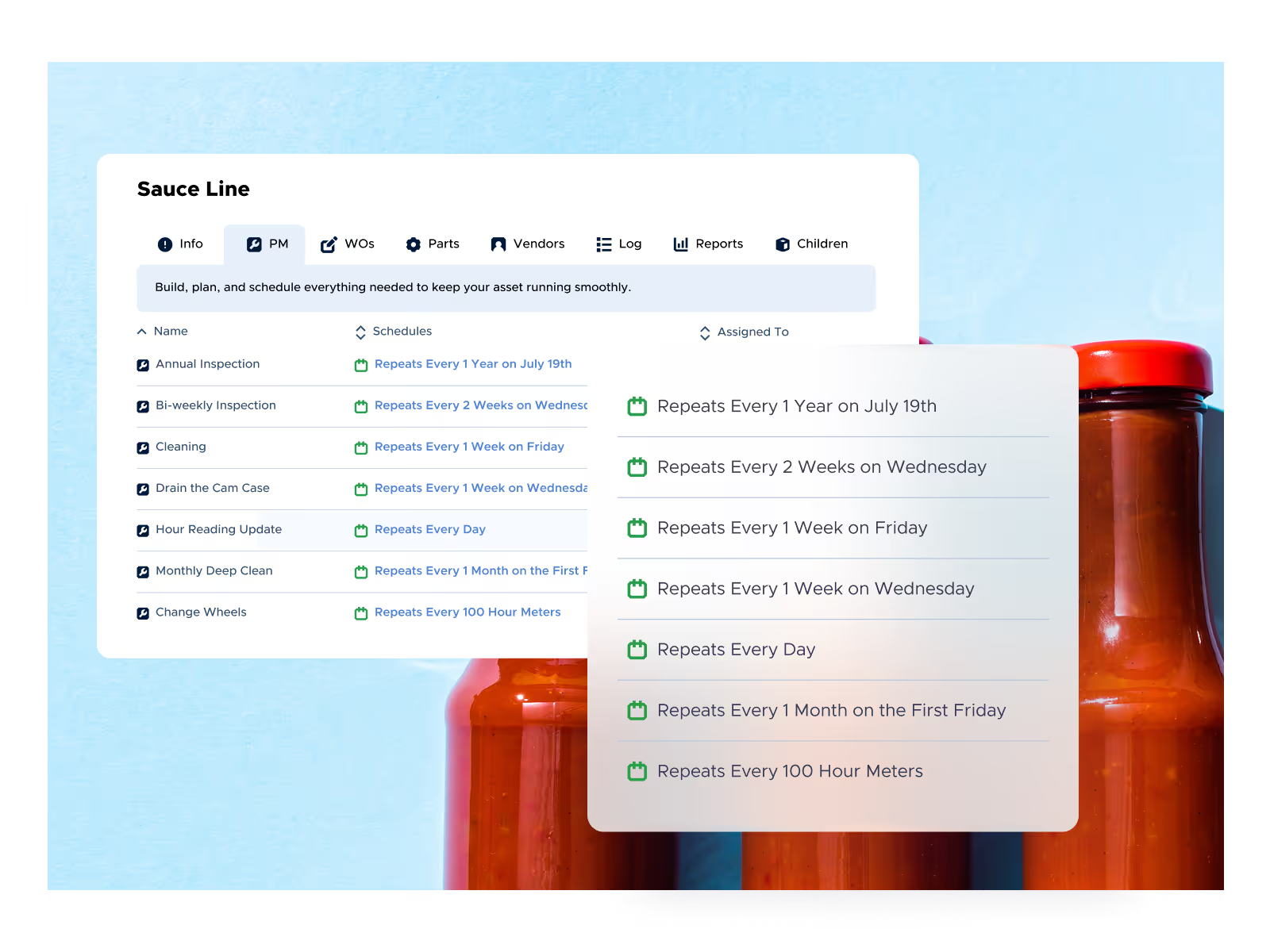
  • Execute data-driven maintenance strategies: Our flexible scheduling module supports optimized maintenance schedules based on time, meter readings, real-time condition data from connected IoT sensors, or even predictive analytics recommendations.
  • Track performance in real time: With customizable dashboards and automated reports, you can monitor all your key APO metrics. Everything you need is visible at a glance, helping you make fast, confident, data-backed decisions.
  • Integrate with other tools and systems: Sensor providers, IoT platforms, ERP systems — Limble provides a deep integration ecosystem with a bunch of helpful automations.

Want to get more value out of your existing assets? Schedule a demo today to see how Limble can power your APO program from the ground up.

Request a Demo

Share your contact details below and someone from our team will reach out as soon as possible.