

The Maturity Roadmap: Your Step-by-Step Path to Prescriptive
Limble's Colin Hilley and AVEVA's Juan Pablo Callados map the path from reactive firefighting to prescriptive maintenance.
See how combining operational data with advanced asset intelligence amplifies your roadmap and accelerates prescriptive impact.
What you'll learn
A clear path forward
Avoid the #1 pitfall
Where AVEVA plugs in
An action plan for tomorrow
Good afternoon, everybody, and thank you for joining me today. My name is Colin Hilli, and I'm the senior manager of enterprise services here at Limble. And I... That's a fancy way of saying professional services. And today, we're gonna be talking about building the core and how you can build a strong foundation within Limble and then how you can connect into our broader ecosystem. And today, I'm actually joined by Juan Pablo. He is one of our preferred partners over at Aviva, and he'll share a little bit about Aviva and how we can take you up the maintenance maturity model.
Right. So jumping in, again, I think this is a strong talking point, here at the summit, but maintenance maturity isn't a race. It's a foundation. You build it once, and then you compound on top of it.
Speed without accuracy or efficiency and reliability just gets you, to failure faster. And I think that's what we see a lot of times is let's just put it in. Let's just get it in there, and that's not always the recipe for success.
Fast track technology on a shaky foundation doesn't accelerate the climb. It makes the chaos more expensive. And I used to be a facilities manager. I've been a plant manager, and I can 100% attest to that one.
Here at Limble, the game plan for growth is as following. We're very incremental. We step by step up the model. No leaps that skip the fundamentals.
We're very intentional. Every capability you add is chosen on purpose, never bolted on, And we're strategic, aligned to the outcomes that actually move your business. And I'm a big advocate for strategy, strategy, strategy. Slow and steady wins the race here, and never sacrifice the core to climb the model faster.
And I think that's a big talking point in what we're about to get into, but you wanna have a game plan for how you grow up the maintenance maturity model. You don't wanna attack it full speed. You wanna be incremental, intentional, and strategic.
One playbook, two plays. So part one is the foundation. The focus here is we're gonna spend fifteen minutes on the mindset and foundation work that makes everything else possible. The key idea is accuracy, efficiency, reliability, reliability, beat speed, and build the core first.
I cannot stress this enough as an implementation manager who's been doing this almost twenty years now. Why it matters? A shaky core turns every future upgrade into a liability, not an asset. And I think that's so true for so many different elements of life in general.
Right? I mean, even in the workout industry, I mean, the one thing they talk about is build a solid core. Right? Have a good core.
Have a good strength around you so that you can build and compound on everything else. And then part two, we're gonna talk about the ecosystem, and that's where Juan Pablo, my copresenter, comes in. But we're gonna talk about the certified partner acceleration, how Limble quarterbacks the right partners once the core is solid. Limble calls the plays.
Partners plug into the core. They don't replace it. The right partner at the right time turns a multiyear climb into a short one. No shortcuts.
No sacrificing the core.
Alright. This should look familiar to those that have joined us in the past. And for those that are just joining, welcome. This is a snapshot of the maintenance and asset management maturity model.
A lot of people that join us here at Limble, they come in right here at the reactive, and that's that's totally fine. That's why you're coming to us here at Limble in the first place. Right? Breakdowns drive everything.
Replacements happen after failures and frustrations. Right?
The pro, it fixes failures fast.
The con, high cost and repeat failures from unplanned work, weak data. And the goal here is to get control of work and gain visibility. Like, this is where we wanna get you out of and build that strong core so you're more in that preventative as starting point. Right?
Work is more stable. We can track history and PM completion liability. The pro here is it reduces surprise breakdowns with planned work. The con is you waste time without risk based schedules, and the goal is to stabilize workload with preventative discipline.
And once we really have a good solid foundation built in Limble with reactive and preventative, that's when we really start to look at how can we continue up this maturity module with condition based, predictive, prescriptive. But, again, we have to be incremental, intentional, and strategic. We don't wanna go from reactive all the way to prescriptive. That's that's literally the recipe for crashing and burning.
We wanna make sure that we're stepping up this ladder the appropriate way and that we're doing what we can do in our wheelhouse, and we're leveraging here our resources at Limble and our partner ecosystem to help us climb the rest of the mountain. This climb is a team effort. It's a win together effort, which is one of our core values here at Limble, and we don't wanna do this on an island, and we don't wanna leapfrog the steps or risk cheating the system to get to where we wanna go. We wanna be intentional and incremental here.
The foundation. Let's get into the foundation and the core.
The foundation.
The foundation has to support real weight. You should never sacrifice it for speed, and you'll hear me say this time and time again. Work order visibility. Every job needs to be tracked. And when I was a maintenance manager and a plant manager, the first thing I'd always say is, like, if it... It's not in our CMMS, if it's not in our system, it doesn't exist. It didn't happen. How can we reconcile that?
PM discipline, scheduled maintenance that actually happens and gets recorded. It's so important that we have an audit record, an audit history of what we've done and what we performed so we can reference that. We can make informed decisions, and we can get to repeatable and scalable in how we run our PM program. Asset history.
We want a full record. When I look at an asset, history and I have a broken record and and I don't know what was fixed and when and by who, how can I make an an informed decision? Right? A full record gets us what's broke, what's fixed, what it costs so I can make informed decisions as a maintenance and reliability manager and a leader in my space.
And then team accountability.
We want you to have clear ownership from work order to closeout. There should be no confusion on who is this assigned to, when was it assigned to them, was it a partner, was it internal. In setting up a clean foundation, you can clearly see who was it going to and why and where was the bottleneck and why, and you can make informed decisions on how to execute next time. If you had a recipe that was clean across the board, that's great. Let's repeat it. Let's duplicate it. But we have the recipe logged in a way that we can reference back to it.
The goal here is build a foundation strong enough to carry everything you layer on top of it. Again, if we don't have a good core and we start stacking things on top of it, we're more likely to crumble and break and fall. And so we really wanna bolt on a strong core and develop that strong core so as we start to layer things on top, it can carry the load with us. It can it can help us get to where we wanna go.
And why this matters? There's no guesswork. Every job part and hour is accounted for.
Who doesn't want that?
No surprises. Planned work protects the rest of the day. Again, all of us are used to being in firefighter mode, guilty as charged, and it's so hard to take our firefighter helmets off. But when we get the foundation built right, we kinda get rid of the surprises, and we can actually have planned days where people get to go home earlier.
You're spending dinner with the ones you love, and and you're getting to do the things you wanna do throughout the day. You're not always having to race to the next work order or get in front of something that you should have taken care of last week. Right? And there's no excuses.
The data holds up when leadership asks. Again, when my boss asks, what are we doing on this status? Or how are we working on this work order? Or how are we doing with the dormitory today?
It's easy when you have a solid foundation to pull up a report, a nice clean dashboard in Limble that shows, here's how we're executing. Here's the PMs completed. Here's where our deviations were. Here's where the pitfalls were.
It's just such a better conversation when you have the data and analytics speak for you.
The foundation, again...
So without a strong foundation, visibility. This is a key one that without a strong foundation, tribal knowledge walks out the door. Only a few people know how anything actually runs. We've all entered an ecosystem and organization where there's one person who knows how to operate that on the shop floor.
There's one person who's the gatekeeper for that. And that's a really dangerous game to play because that person exits or heaven forbid something happens. You you don't know how to execute against that, and and we don't want that. We want a plan.
We want work visible and tracked by everyone, any shift, any debt. There should not be one gatekeeper. There should be multiple, and there should be universal access to how we exchange the information and how we run our day to day.
Planned work, when we look at without a strong foundation, emergency work drowns everything out, and I think we can all attest to that. When emergency come...
Work comes in, everything else goes to the back burner. We could have, a birthday we were planning to celebrate internally for one of our team members, and that goes out the door. We gotta go fix this hot water heater. We can't eat cake and ice cream and get to do the fun things.
We have to go do that. But with planned work, that protects the day. P happens on schedule, on record. And guess what?
If you do it on time and earlier, you are eating birthday cake and celebrating an internal team member, and that's so important. And we want that for you here at Limble. Data trust. Nobody trusts the data enough to act on it.
Decisions default to gut feel.
Again, that's something that we don't want you to have to do here at Limble. That's why you're coming to a CMMS, specifically Limble, because we want you to trust your data. And with data that you can rely on, your team actually believes and uses to make the next call, that's a powerful, powerful tool. When they can say, man, that that data is accurate and reliable, well, now they're making informed decisions, and now they're confident in what they're about to execute against.
What comes next? Without a strong foundation, every new tool inherits the chaos. Automation just fails faster. Everything that we try to compound on top of what comes next from these these counterpoints or these data points that we're discussing right now, it just becomes shaky. We can't compound on top of it.
But if we have a strong foundation, every new partner adds real value, and that's what we wanna do here at Limble is we wanna activate different partners, different methodologies within our ecosystem so that there's a solid base to build on and that you can really go up that maintenance maturity model the right way.
And now the ecosystem.
Certified partners, one quarterback, faster without shortcuts. And, again, that's a key one. No shortcuts here.
Let us here at Limble be your quarterback and help you identify the right partners at the right time once we have a solid foundation.
So Limble calls the plays. One core, a bench of certified partners, you get where you wanna go.
And so here at Limble, consider us your quarterbacks here in professional services or enterprise services, and we'll help you figure out when the timing's right for condition modern, monitoring. And we'll talk about that with our flagship partner, Aviva.
IoT and sensors, certified partners, we have a plethora for that. Erp and finance, again, we've got an ecosystem that we can get you tapped in there and and do a free flow exchange of data. But, again, the data has to be valid. The workflows have to be valid from that foundation, that core.
And then procurement, same thing. We can help you with purchase orders from end to end. Where's the start and stop mechanisms? How does this work for a tech on the shop floor?
All the way from a manager and supervisor trying to actually get that bill paid and get that vendor materials and bill of goods received at your at your plant. We wanna make sure that Limble is helping you from a strategic level. We've talked about the incremental growth. We've talked about the intentional.
And at the strategic level, we really wanna make sure that you understand that here at Limble, we provide you with the quarterback that helps you with the strategy. Once your foundation is solid and we help you with that and we really tighten the screws there, let us quarterback the rest and figure out which partners to plug in where, where to compound them best, and how you're gonna get the most value out of Limble and our partner ecosystem.
The ecosystem spotlight. So, again, one certified partner unlocking the last mile of the climb, multiply this across the bench. So, again, we have so many partners. We have a a breath of things we can activate here at Limble for you.
We just need to make sure you have the strong foundation. And, again, let us evaluate and be your strategic partner along the way so we figure out what is the last mile, where is the last mile, and who helps us close that loop so that we get to the last mile. And we're not out of breath, but we're finishing strong. We're crossing that finish line.
We're putting our arms up. We're going, like, let's go. We freaking made it.
Condition monitoring, real time signals, asset held data feeds straight into the core. This sharpens condition based confidence. Predicted analytics, seeing it coming.
That's where I wanna go when I when I think about the maintenance maturity model is seeing where it's coming. Failures get flagged before they show up on the floor.
Accelerates the predictive stage. Right? This really helps you understand what's about to happen so you can get in front of it. You're not getting those phone calls at 2AM. We already solved for it at 10PM before that shift got off the rotation.
Prescriptive guidance, recommended actions, not just alerts.
The next best move unlocks the prescriptive stage. Right? And, again, this is where we can leverage a talented partner like Aviva, and I'm not gonna steal one Pablo show. He's gonna speak to this. But we have so many talented partners, so many talented people here at Limble that can help you with this.
And the goal here is see what one certified partner unlocks, then imagine the rest of the ecosystem. Again, let us call the place here at Limble. Let us show you the value. Let us demonstrate the value. And once you really start to tap into the value, we can start to unlock other avenues you didn't even know were possible in your ecosystem.
What stays the same? The core. Again, this is why we talked about the core in the beginning. This is why it's so important.
But the work orders, the PMs, the asset records, that stuff doesn't change if you've built it right. We're just compounding on top of it. Your workflow. Aviva signals flow into Limble, not around it.
So, again, when we think about a partner ecosystem, we're flowing and exchanging data into what you've already built. And so it's cohesive. It sticks together, and it makes sense, and it unlocks real value. And then for your data, one system of record from reactive to prescriptive.
We don't wanna have to ref...
Reference multiple systems. We're straddling two solutions.
We wanna create an ecosystem for you here at Limble where the data flows in cleanly. It lands where it needs to land. It's shared. It's a clean exchange, and you're not straddling two systems.
There's one login, and your techs know where to go. Your supervisors know where to go, and the data is reliable. It's valid. And our partners help with that.
A good foundation helps with that. And more importantly, here at Limble, we help you build that strategic pattern to bring it all together.
Next steps, moving along the maturity journey.
So the next steps for your team, there's three moves in order. Each one makes the next possible. As you sit here today and you join me for this portion of the summit, assess your current stage, and just be honest with yourself. Use the maintenance maturity model.
Find where your plan sits today. Be honest. Most teams are earlier than you think, and I think that's something that we have to really sit back and have some introspective on. Share the result with your leadership before proposing anything new.
Again, don't don't cheat yourself. Don't cheat the system. Let's be intentional. Let's be incremental, and let's go after what we really wanna go in a strategic way.
Accuracy starts with an honest baseline, not a wish list. And I think that's the biggest thing I can have you walk away with today is be honest. And if you have a wish list, that's great. But let's build a strategy around how we get that wish list from a wish list to an actionable list or your reality.
The foundation strengthen the core.
What we need to do here is we need to nail work order visibility, PM discipline and asset history first, fix data quality before adding anything that depends on it. So if you're not confident in your data quality, again, that's something here at Limble and with our partner ecosystem we can help you with. Let's get your data quality scrubbed and refined and brought into the system the right way. Let's audit it.
Let's analyze it. This is the fifteen minute foundation. Don't skip it. You have to have clean data.
You have to have your your system and your foundation set up correctly if you really want to advance.
Efficiency compounds. A solid core pays off on every stage after it, and that couldn't bring more true here at Limble and just in the maintenance maturity model world in general.
The ecosystem, layering the right partners, and that's a keyword right there, the right partners. I think there's a lot of partners out there. And here at Limble, we truly try to partner with the best of the best intentionally because we want you to have the right partners that add the right value at the right stage of your maintenance maturity climb.
So what we're gonna do here is we're gonna bring in certified partners once the core can support what they unlock. And, again, if you're unsure if your core can support what we're trying to get to, that's where you have a strategic partner or quarterback here at Limble that wants to help you, that wants to see you successful, that wants to see you thrive and get to where you wanna go. Again, turning that wish list into a reality.
Start with condition monitoring. Aviva is our flagship example. And, again, Juan Pablo, my my co, correspondent today, is gonna speak to that, but let Limble quarterback the ecosystem. You focus on the plan.
You've got enough to do. That's why you're hiring us. That's why you're bringing us in. We're here to help.
Reliability is the point. Limble calls the place. Partners are the roster, not the shortcut.
Thank you for your time. I'm gonna pass it to my partner, Juan Pablo.
Thank you, Colin, for a great presentation and handover. Hello, everybody. My name is Juan Pablo Goyalos. I am with the Aviva company, and I am a technical consulting leader for advanced applications here in The Americas. Thank you for the opportunity to address you today. What I would like to do is, to start out with a brief introduction of what Aviva is, who we are, and what we do.
Many of you are running fantastic maintenance programs and asset strategies. However, our paths may not have crossed in the past, so I wanna take a couple of minutes just to orient you in terms of what Aviva is.
We offer a holistic portfolio that is purpose built for industry spanning the life of the asset from simulation and learning to engineering and execution, operations control, asset performance, production optimization, and planning and scheduling.
We have a rich ecosystem of developers and third party partners.
Limble being a strategic partner of ours enables us to extend our value to your application, specifically maintenance management.
What I wanted to drive through this slide is if you beat it from the bottom up, our foundation really resides within industrial information sharing and management.
It's the power of the data, the data that's in your building today. That data spans across engineering, IT data, and operations data. So when we look at the bottom layer, assets and devices, we infuse this data foundation on top of that, and we look at all the applications that are relevant to various use cases, to various personas that drive different value across the organization.
And offering those solutions at industrial software platform in one integrated experience is really what Aviva is all about.
It's a busy slide, but I'll simplify it as much as I can. It's important because it drives the importance of connectivity, the importance of a strong data foundation.
And that's where we start on the top left hand quadrant with data management and visualization.
We refer to this as the industrial knowledge graph. You can think of it in different terms. Some people refer to it as the digital twin. Digital twins are software platforms that can mimic essentially processes and assets, physical assets, and introduce a rich data context to any decision making that's associated with it.
So here's where we contextualize, we harmonize the data, we provide modeling, governance, and validation, and we store much of the data that's going to be used through the AI and analytics part of our solution set.
This is where we offer services around what we refer to as the industrial AI assistant, AI assisted digital twin, machine learning analytics, calculations, agentic frameworks, and intelligent data flows.
This enables collaboration, collaboration through our connect platform.
We refer to these as communities, and it's all about data sharing, project sharing, business intelligent tools, and you can see some of our partners such as Microsoft Snowflake and Databricks for enterprise data integration.
Driving towards the Limble solution is where we talk about applications.
Applications around asset performance management and operations from an Aviva perspective encompass asset strategy optimizations, understanding the criticality and the capital investment impact of each and every asset or asset systems. We roll that app into a site and the enterprise.
We offer point solutions around mobile rounds, predictive maintenance, operations control, manufacturing execution systems, of course, the pie data infrastructure, and other engineering solutions.
The connect marketplace is what brings it all together, where we have our partner apps and services including Schneider Electric, Limble, of course, close collaboration with BrainCube, ProcessVue, and ETAP and RAB.
On the bottom is our connectivity layer. So none of this works without being able to connect to different systems and introduce standards, protocols, operations, technology, engineering, IT, data processing, and data access.
We are industry independent and agnostic. So all of the solutions that I'm referring to in this slide apply to a wide variety of industries, use cases, and personas within those industries.
I'd like to dive down a little bit more into our connect marketplace platform because it's the essential pillar that drives our connectivity with our partners. Again, reading from the bottom up, you're looking at the typical Aviva systems. It can be Aviva process historian, system platform, manufacturing execution systems, or a Viva Edge and data store. It all rolls up into our PI server, although we have connectivities to various site level historians that hold operational data or enterprise level solutions such as pie. From here, we use Aviva Connect data services to drive visualizations and analytics.
We overlay with the Viva applications, in house apps, and partner apps. In house applications being different applications that you might have on-site, on prem, or on SaaS that would be part of the overall solution, especially when it relates to reliability strategies.
This is how we connect with Limble, and this is how we drive automatically maintenance work processes that are based on very much what Colin was talking about, that maintenance maturity pyramid. Once you get into advanced condition based monitoring and into predictive analytics and continued... Continuous improvements, this is what... This is the technology platform that enables that journey into the upper tiers of that pyramid.
I wanna give you a a sense of what connect data services really means. It's a fancy term to describe the ability to visualize on a sensor by sensor basis, and these would be sensors that are associated with your assets that you have in your facility, your process lines, your manufacturing lines. It could be anything from a pump or a motor to more complex rotating equipment like a compressor as an example. We're very asset type agnostic.
Here, I can visualize a tag, and a tag is simply a reading, in this case, coming from PIE, that is showing me trends. This could be the temperature, a vibration. In this case, we're looking at suction pressure for a pump.
I can use this information to literally create a data mapping to Limble. We would do this generally in the asset card where we can define what we refer to as a connect stream. A stream gives you the ability to, in real time or near real time, publish this information in the Limble system.
I wanna give you a couple of examples from integrated use cases, two of them for today.
A simple one, yet when I visit customers, I still see a lot of preventative maintenance programs that are focused on calendar based or OEM based triggering mechanisms to drive maintenance work. There's a very simple way to use connect data stream from historian, a process historian. In this case, I'm gonna use the the pie example.
To look at asset run times, this could be units produced. It could be a variety of applicable meters and gauges that empower you to take a single reading in terms of run time hours of operation or operational days to automatically update the asset limbo card, specifically the preventative maintenance task that's being set up, for example, on a pump or any type of equipment assembly where I'm going to trigger work or an inspection at 4,500.
We can automatically use that stream to update Limble at your desired frequency. It could be once a day. It could be once every minute. It could be once a month.
Limble continues to aggregate the number of days or hours or meter readings, gauges, etcetera. And when the triggers are reached, we create the Limble task, and the normal workflow in Limble takes place going all the way through planning, scheduling, execution of work or inspection through the mobile device, and finally, the closure, ideally where you're tracking some of the reliability information as found as left, if possible root cause, action taken, remedy, etcetera. I bring that up because we have the ability to bring that information back into Connect to drive further analytics.
For example, overall asset health scores based not just on real time performance of the asset, but the maintenance history. What have we done and how many times and what has it cost?
Those are all important analytics pieces as you go through future repair and replace decisions, or you go through an anomaly detection work process, where you need information from past maintenance events.
A second integrated use case would be more of a multivariate condition based maintenance application.
One example could be a vibration based notification using Limble Logic. For example, when a booster pump vibration notification comes up, this could be using an accelerometer or proximity probe sensor attached to the pump's bearing or housing shaft.
What we're looking for is pole displacement or potentially oscillatory readings from PIE. So this information is going back to PIE where we can do some analytics. We can determine certain bandwidths around excess vibration to trigger that maintenance maintenance inspection task. We can identify issues such as unbalance, misalignment, or bearing wear.
The ability to use the PM system in Limble gives you open space to create work packages is what I like to refer refer them to ask. The idea is that we're no longer working off of the calendar, but we're creating a set of PM tasks that may already have the typical steps for an inspection or repair work, the typical labor requirements for an unbalance or misalignment situation with the pump, could be P and ID attachments, diagrams. So what we end up end up creating in Limble as a result of this type of monitoring, deterministic monitoring I'll refer to, is a work package, something that a planner or a supervisor can look at.
And it doesn't just have the information that might be associated with a work request. It's a full work package where you can still do some planning, you can still make some changes, you can add things, remove things, but it gives you a head start in terms of throughput. Being able to go from a real time notification to an analytics at the edge that create a notification into connect that creates a work package in the maintenance system in Limble.
You can apply this to multivariate conditions where the logic would be done in pie, for example, where I can have a multidimensional condition based monitoring capability. For example, I can pull pi for two correlated booster pump asset tags or streams. I can build and execute an expression in pie. This would be a compound expression which automatically updates Limble CMMS. I can compare, for example, and contracts compressor inlet pressure to flow with pump status. Is the pump on or off?
For example, if the pump is on and the flow is over 35 psi, trigger a work task, an inspection work task, for example, in Limble. Inspection task is created there.
There are unlimited use cases that you can apply to the combined solutions from Aviva and Limble, tie in your manufacturing execution systems, or any other condition based application, whether it be in house or third party such as thermography, oil spectography that can help to automatically and deterministically drive work processes into Limble.
I wanna touch on a slightly different theme, which is the ability to utilize Aviva applications to help you through a troubleshooting scenario. So this use case is less deterministic. Let's say that our operations platform, whether it be a a historian, a SCADA system, it could be a system like PIE, it could be a predictive analytics system, gives you a notification that something is going wrong with a piece of equipment or a system, an assembly, a group of pieces of equipment.
This can be a daunting challenge for many of our customers. So if I can take you through what I see a lot with our customers, an alarm is received, something breaks.
Someone like a reliability engineer or a maintenance practitioner, perhaps it could be someone from operations, picks up the phone and needs some maintenance resource to get a better understanding. There's some dialogue that may happen between maintenance and operations. Maybe today, this is just handled within the operations group.
What tends to happen is in order to make a determination if this is a real problem, is it a process problem? Is it a problem with the way you've defined your condition based monitoring capabilities? Is it a problem with a digital twin predictive analytics capability where you have to redefine your model to to have a little more accuracy on what we're detecting? Or is it actually an equipment problem and I have to engage with maintenance? I have to mobilize a maintenance resource or a group.
If the information is accessible, we walk down to it. These could be filing cabinets. It could be a variety of different types of operational data from system to spreadsheets to to be able to analyze and make or validate the hypothesis that a reliability engineer might have in terms of dealing with this troubleshooting.
You typically like to check for maintenance data to see if this has happened before. You might interrogate the OEM to find them or find a manual for insights to help you through this. You might look at industry information or do an inter... Internet search to help you with validating your hypothesis.
Sometimes you make your best guess at the time of recommendation to move forward.
These processes I see all the time. They're manual. They're time consuming. Information is typically siloed. Some of the information may be skipped to expedite the process, often hard to find, hard to access. Key individuals may not be available. The key people you need to talk to that have a tribal knowledge just may not be there.
There's a heavy dependency on subject matter expertise and tribal knowledge.
So what I wanted to show you, and I'll show you a quick demonstration of capability here, is a rendering of visualization. I'm not gonna get into the details of the visualization layers because there are several options from a Viva on prem, on cloud.
Suffice it to say, we display the data that's needed to cognitively go through the troubleshooting process.
Starting with the digital twin in this particular screen, this is the diagram that you're seeing that represents an equipment process graphic with steam turbine generator condenser and cooling flow context.
And the typical things that we're looking for to troubleshoot, in this case, it's a high vibration alert that I'm getting.
You're seeing by scrolling down into this dashboard. So we're looking at the equipment level maintenance strategy summary, which gives me information relating to consequences from a safety environment and cost perspective. There's different ways of measuring these. We're using class two or zero through five in this case, and you can see those classes there.
I've gone back to the top screen. Let me just go back to that asset screen again.
I was referring to the consequences. Also, information from, in this case, Limble maintenance counts in the past twelve months... Twelve months. These are maintenance events that have occurred with their priority. This is gonna give me an indication of past history, and perhaps I need to go into the Limble system to get that type of information. Some high level metrics around meantime before failure, meantime to repair, expected equipment life is something that we can get from Aviva platforms, platforms, percentage of reoccurring failures, maintenance costs. From a predictive analytics perspective, we're looking at the risk score. Think of this as an asset health score, and we're combining Aviva engineering information to drive efficiency.
Is the asset or the system operating in a state as was designed? Have there been any modifications? That's gonna drive some of the efficiency capability.
Going down below and looking at distributed control systems or supervisory control and data acquisition alarms. This is what's coming from the plant from the plant floor. Operator logs, nameplate information for the asset, CBM health, and open work requests. I have several layers of dashboards that I can show you. Suffice it to say that we have simplified the process of cognitively going through asset anomaly detection, understanding data driven insights that take you to prescriptive actions, the creation of potential work in a system like Limble.
That's all the time I have today. I really appreciate your attention to this. I look forward to continuing this conversation. Thank you very much.
KEEP WATCHING
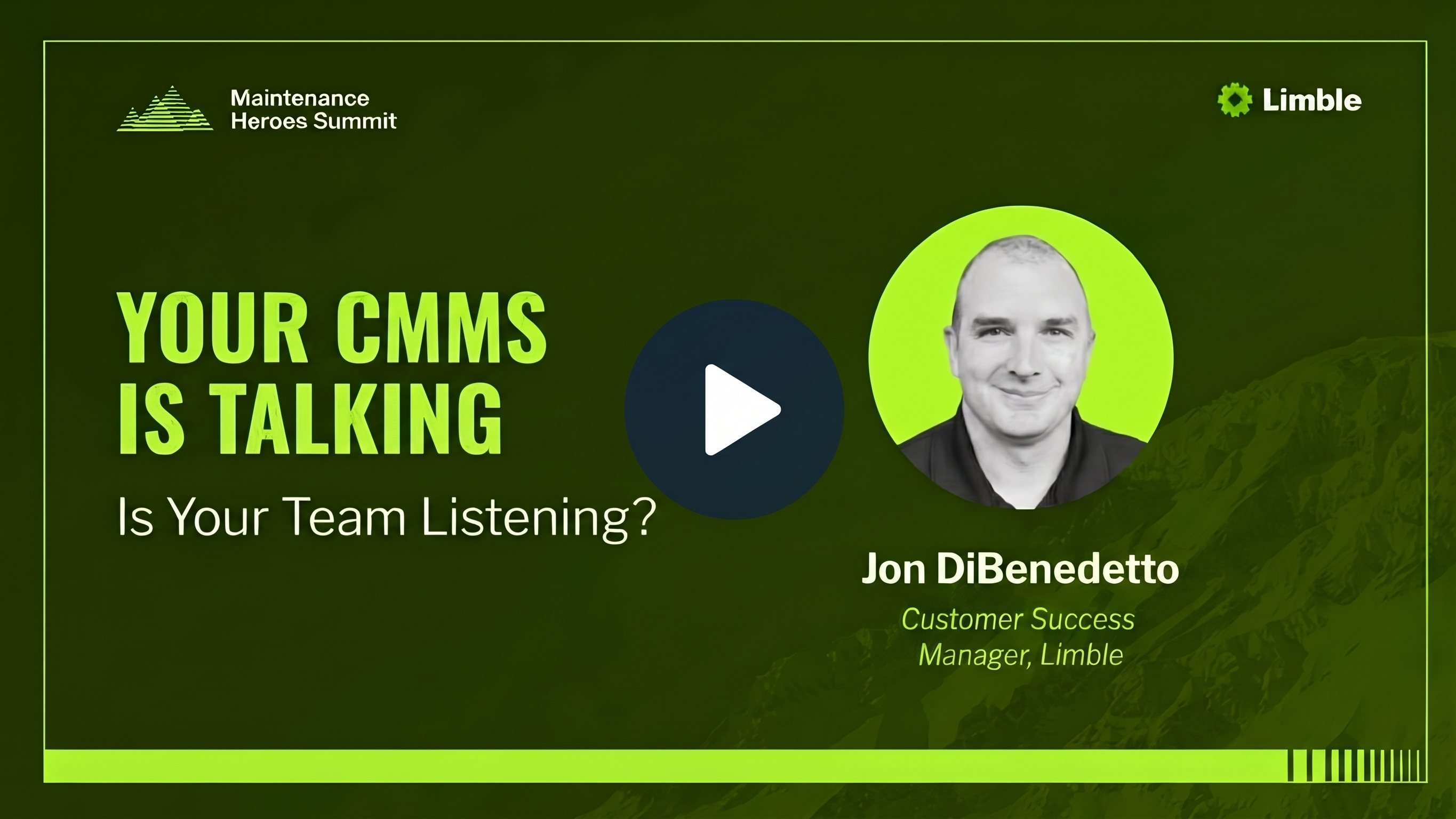
Your CMMS Is Talking. Is Your Team Listening?
Jon DiBenedetto, Limble
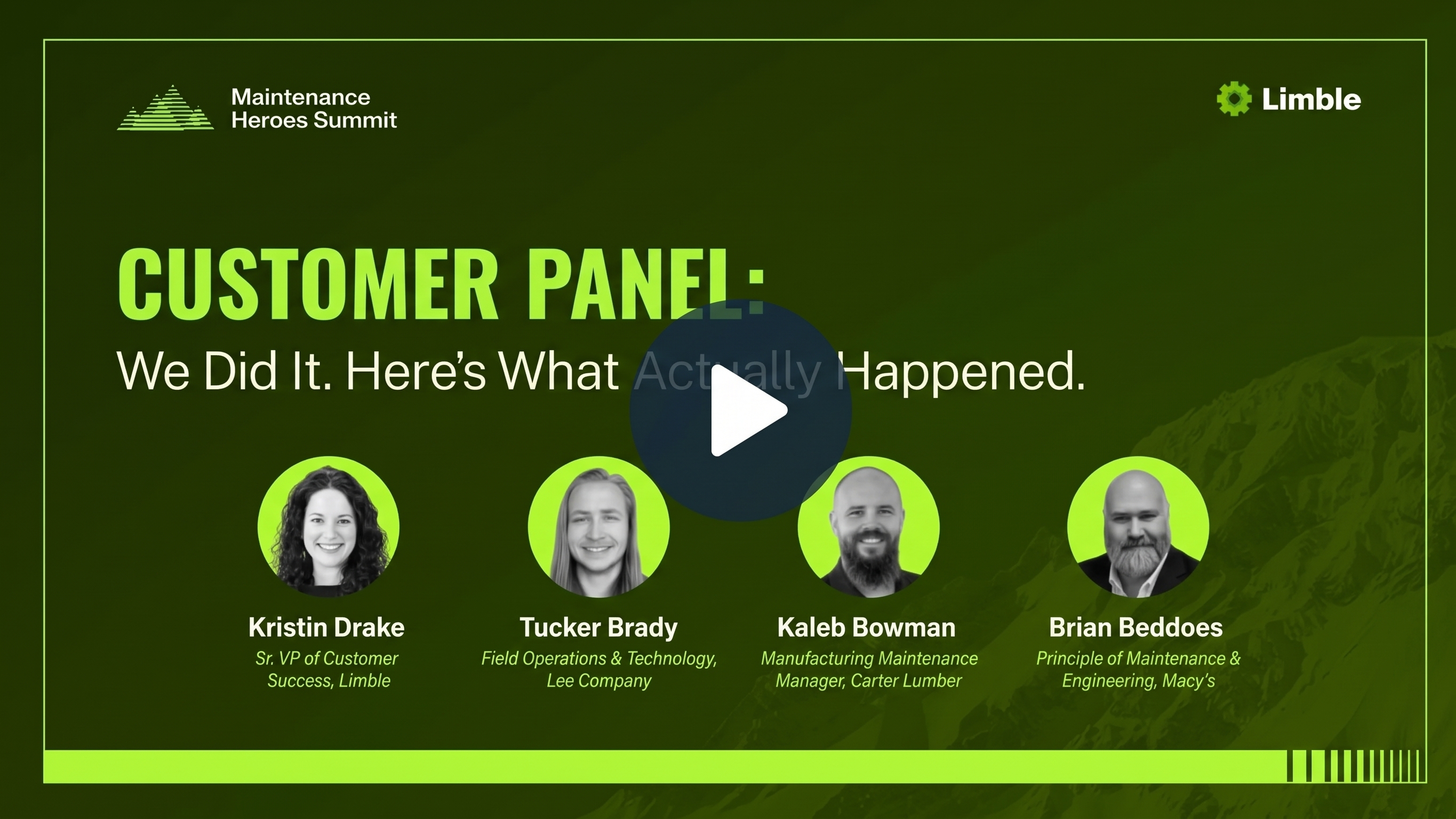
Customer Panel: We Did It. Here's What Actually Happened.
Lee Company · Carter Lumber · Macy's
What's New from Limble: Product & Partner Showcase
Jason Penkethman · Lauren McCarthy, Limble